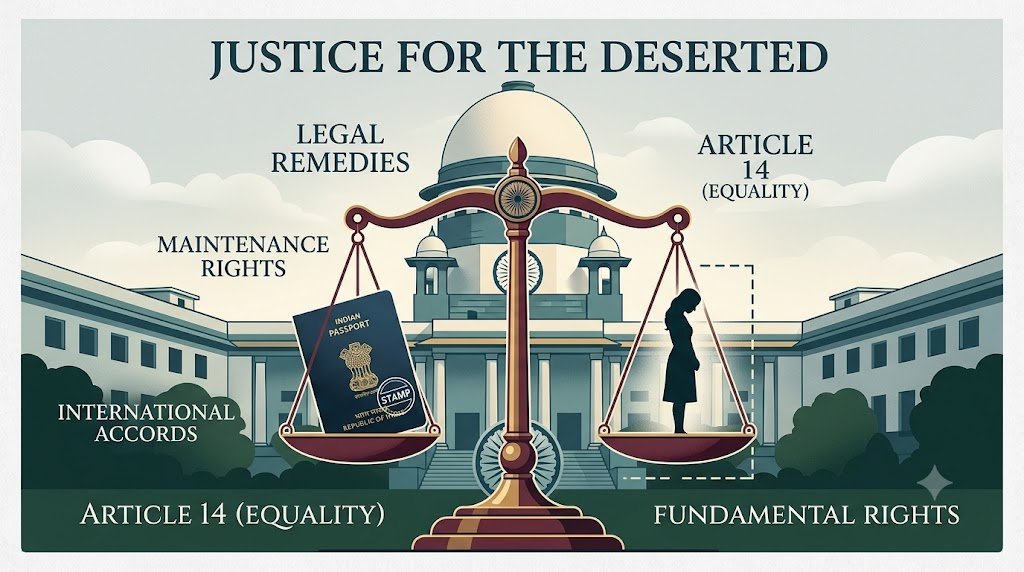
Each year, thousands of men leave India to work abroad, and many return home to find a bride. However, in some cases, NRI wives are abandoned in India after the man marries, takes the dowry, and never returns. Without a proper divorce, these women cannot remarry and are forced to live with social stigma.
In other instances, women are taken overseas, abused, and deserted. Wife abandonment often goes hand-in-hand with domestic violence and dowry harassment, leaving wives stranded in unfamiliar foreign environments, divorced without their knowledge or consent, and unaware of the local legal systems.
Common Problems Faced by NRI Wives
- NRI husband abandons wife without financial or emotional support.
- Bigamy: The husband is discovered to be already married or living with another partner.
- Physical abuse and domestic violence.
- Ex-parte divorce acquired legally abroad without the wife’s knowledge.
- Misrepresentation of financial and immigration status.
- Child custody disputes and related legal complications.
Reasons Behind NRI Wife Abandonment
- Large Diaspora: India has one of the largest diasporas globally, with nearly 32 million Indians or people of Indian origin, increasing transnational marriages.
- Community Pressure: Men often seek brides from India due to cultural or familial pressure to marry within their community.
- Social Status: Some families consider marrying an NRI prestigious, believing it guarantees a prosperous life overseas.
- Lack of Strong Deterrent Laws: The absence of stringent cross-border legal frameworks emboldens offenders.
Real-Life Case Studies
- Case 1 (Anitha’s Story): A software engineer from Andhra Pradesh married a UK-based groom in 2012. After years of delay, she was brought to the UK in 2016 while pregnant, only to discover her husband already had a British partner and children. She was confined and isolated until her family rescued her. She later faced legal hurdles in India as her husband evaded court summons.
- Case 2 (Lakshmi’s Story): Living in Ireland with her husband and son, Lakshmi was brought to India on the pretext of visiting relatives, after which her husband flew back alone, leaving her stranded with no money or means to return, subsequently demanding an online divorce.
Scale of the Problem
Between 2015 and 2019, the Indian government handled over 6,000 cases. The National Commission for Women (NCW) received 2,846 complaints between 2017 and 2021, while the Ministry of External Affairs addressed 4,698 complaints during 2016–2019. States like Telangana, Punjab, Andhra Pradesh, Haryana, and Kerala have even established specialized NRI police units.
Lacunae in Current Laws
- The Indian Penal Code (IPC): Complaints under Section 498A often prove toothless because foreign nations frequently reject extradition requests, and court summons fail to reach recipients through diplomatic channels.
- Code of Civil Procedure, 1908 (CPC): Foreign matrimonial judgments lack direct enforceability unless they fall under “Reciprocating Territories” as defined under Section 44A of the CPC.
- Inadequate Financial Assistance: Government aid covers stranded women overseas, but offers no support for cross-border litigation or extradition.
- Validity of Marriage & Private International Law: India lacks robust private international laws and has yet to ratify key Hague Conventions concerning civil documents, bigamous marriages, and child support.
- Jurisdictional Conflicts: Cross-border separation renders judicial decisions largely unenforceable across different legal jurisdictions.
- Passport Impounding Issues: Although Section 10(3)(h) of the Passports Act, 1967 permits passport revocation or impounding against proclaimed offenders, implementation remains dismally low relative to the thousands of pending complaints.
Proposed Legislation and Supreme Court Intervention
The Registration of Marriage of Non-Resident Indian Bill, 2019 was introduced to mandate marriage registration within 30 days in India, empower courts to attach properties of proclaimed offenders, and enable passport impounding. However, due to ambiguous definitions regarding ‘NRIs’, it remains under review.
Concurrently, public interest litigations (PILs) filed in the Supreme Court by affected victims and organizations like the Pravasi Legal Cell have urged the apex court to lay down comprehensive guidelines for embassies, police, and immigration services to ensure swift justice and legal aid.
Conclusion and Recommendations
Experts and legal commissions suggest urgent structural safeguards:
- Enactment of a centralized, uniform marriage law governing NRI unions.
- Mandatory registration of all marriages within India.
- Active participation and ratification of international conventions like the Hague Conference rules.
- Strengthening personal laws concerning maintenance, alimony, and child custody across borders.
- Heightened pre-matrimonial background verification and family awareness.