The hijab controversy has been one of the most dominant news topics in recent times, raising critical legal questions regarding the freedom of religion and whether the right to wear a headscarf is constitutionally protected.
The case has been heard by the Karnataka High Court for final orders, with the interim order dated February 10, 2022, continuing until further directives.
Interim Order
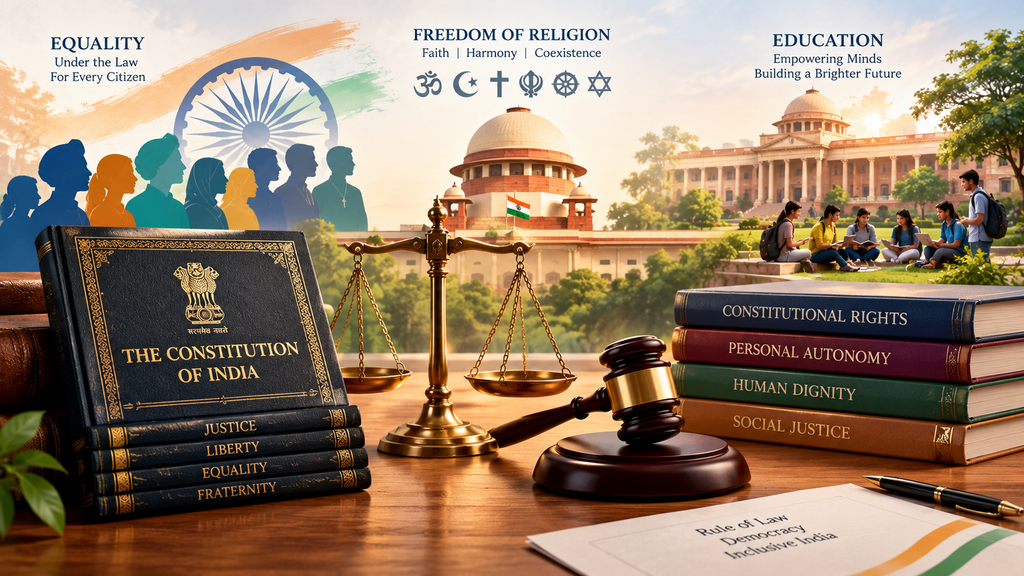
On February 10, 2022, the Karnataka High Court passed an interim order in response to petitions challenging the hijab ban in state colleges. The court requested the state government to reopen educational institutions at the earliest while restraining students from wearing any religious attire in institutions where a prescribed uniform dress code is enforced.
Case Details
Registered as Resham & Anr. v. State of Karnataka & Ors. (along with connected writ petitions like WP No. 2347/2022), the petitions were filed by Muslim girl students challenging government college restrictions on wearing headscarves matching the uniform color. Due to “questions of seminal importance,” a single bench referred the matter to a larger three-member bench comprising Chief Justice Ritu Raj Awasthi, Justice Krishna S. Dixit, and Justice J.M. Khanzi.
Key Legal Questions Before the Court
- Whether wearing a hijab constitutes an essential religious practice under Islam.
- Whether state interference in such matters is constitutionally warranted.
- Whether wearing a hijab falls within the ambit of freedom of expression under Article 19(1)(a) and whether restrictions are permissible solely under Article 19(2).
Facts of the Case
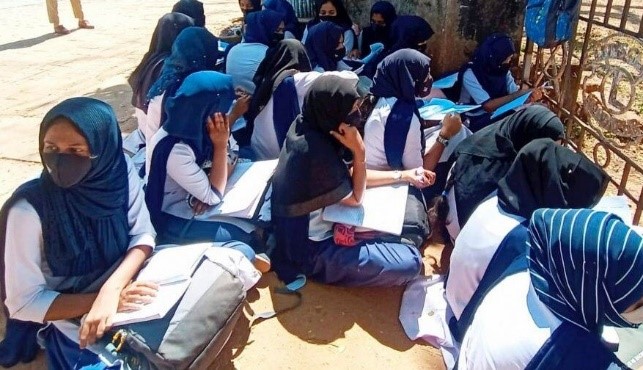
Petitioners—students of a Government Pre-University (PU) college in Udupi, Karnataka—were barred from attending classes for wearing headscarves over their uniforms. Efforts to resolve the issue locally led to protests, counter-protests involving saffron scarves, and subsequent state government orders invoking Section 144 and banning clothing that disturbs public order.
Contentions of the Petitioners
- Essential Religious Practice & Article 25: Wearing a hijab is protected under freedom of conscience and religion, supported by precedents from various High Courts.
- Freedom of Expression (Article 19(1)(a)): Clothing forms part of personal expression and identity, and restrictions must strictly satisfy the threshold of Article 19(2).
- Statutory Rules: Advocates argued that existing Karnataka education rules do not mandate uniform enforcement in pre-university colleges in the manner claimed by authorities.
Contentions of the Respondents (State Government)
- Uniformity and Discipline: Under Section 133(2) of the Karnataka Education Act, 1983, the state mandated uniforms to promote equality, fraternity, and institutional discipline.
- Non-Essential Practice: The government argued that headscarves are not an essential religious practice and therefore lack constitutional immunity from reasonable institutional regulations.
Conclusion
The ongoing legal battle underscores the complex interplay between institutional discipline, secularism, and individual constitutional freedoms in India.