Cases of hate speech and hate crimes, along with allegations surrounding them, have seen a sharp rise in the country in recent years, with social media often acting as a catalyst. In January 2022, multiple high-profile cases came before the Supreme Court. On December 31, 2021, Jamiat Ulama-e-Hind and Islamic scholar Maulana Saeed Madani filed a petition concerning such crimes, detailing several incidents and the actions taken.
Additionally, in January 2022, the Supreme Court restrained police from taking coercive action against individuals accused of posting on social media regarding the Tripura violence, which is widely regarded as a hate crime. Around the same time, 76 Supreme Court advocates wrote a letter to Chief Justice N.V. Ramanna praying for suo-motu action against open hate speeches and calls for genocide made in Haridwar and Delhi, which subsequently led to police filing FIRs. Other notable controversies, such as the Bully Bai App case and the Kerala High Court directing an FIR against a Christian preacher for hate speech targeting Hindus, highlight the growing gravity of the issue. Furthermore, a 65-year-old minority community member subjected to physical violence based on religious identity approached the Supreme Court seeking compensation and punitive action against negligent police officials.
What Are Hate Speech and Hate Crimes?

In simple terms, a hate crime is an offense committed against a group or its individual members driven by feelings of hatred toward that specific community. Unlike ordinary crimes, the offender expects no personal gain and holds no personal enmity toward the victim; the act is committed solely because the victim belongs to a particular community, caste, color, religion, national origin, race, or gender. The resulting injury may be physical, material, or reputational.
- Forms of Hate Crime: Caste clashes, communal violence, and mob lynching represent the most heinous manifestations of hate crimes. Mob lynching involves crowds taking the law into their own hands, often fueled by group prejudice.
- Hate Speech: Speech that incites groups or communities to commit such crimes.
According to Black’s Law Dictionary (9th ed. 2009), a hate crime is defined as a crime motivated by a victim’s race, color, ethnicity, religion, or national origin. Globally, similar trends appear in anti-immigrant violence in Europe, racially motivated crimes in America and pre-independence South Africa, and brutal sexual violence during communal riots aimed at “punishing” targeted communities.
Why Is It Necessary to Stop Hate Crimes?
- Innocent Victims: The targets are typically ordinary, innocent individuals.
- Extreme Cruelty: The motivating factor is to inflict maximum psychological and physical pain to express hatred, resulting in exceptional brutality.
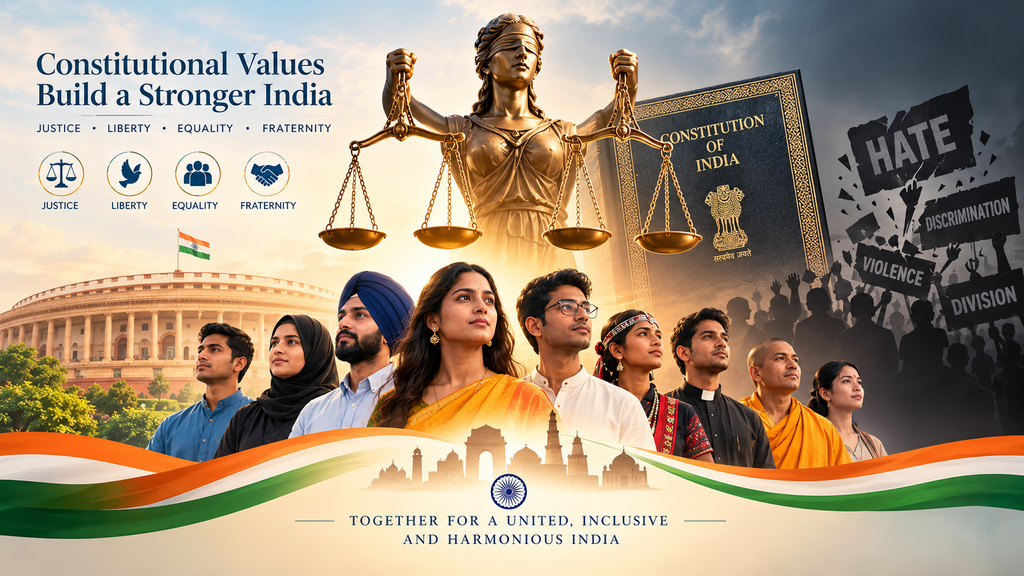
Such offenses tear at the normal fabric of society, promote anarchy, and pose a severe threat to a pluralistic nation like India. This necessitates stricter legal deterrents.
Difference Between Normal Crime and Hate Crime
While ordinary crimes require establishing actus reus (the physical act) and mens rea (the mental intent), proving a hate crime requires demonstrating hatred as the primary and sole motivating factor.
History of Hate Crimes in India
The history of hate crimes in India predates independence, notably culminating in the partition riots—among the worst genocides in history. Subsequent decades witnessed tragic incidents, including the 1984 anti-Sikh riots, the 1992 Mumbai riots, the 2002 post-Godhra riots in Gujarat, and the January 1990 exodus from the Kashmir Valley. Hate speech, hate crimes, and mob lynchings continue to make alarming headlines today.
Social Media’s Contribution
While social media offers significant positive connectivity, digital technology has given hate crimes a dangerous new momentum. Platforms frequently serve as conduits for spreading unverified rumors. Incidents like the Tripura violence and related clashes in Maharashtra underscore how online misinformation can trigger physical violence.
Legal Provisions on Hate Crime
Although India lacks a single dedicated comprehensive statute specifically titled a “hate crime law” (apart from the SC/ST Atrocities Act), several provisions under the Indian Penal Code (IPC) and other laws address these offenses:
- Section 153A IPC: Punishes promoting enmity between different groups on grounds of religion, race, language, place of birth, or residence, with enhanced penalties if committed at places of worship.
- Section 153AA IPC: Penalizes the willful carrying of arms in processions or organizing mass drills with arms.
- Section 153B IPC: Addresses imputations prejudicial to national integration.
- Sections 295, 295A, 296, 297, and 298 IPC: Deal with offenses relating to religion, including injuring places of worship, malicious acts outraging religious feelings, and disturbing religious assemblies.
- Section 302 IPC: Applied alongside Section 34 (common intention) or Section 149 (unlawful assembly) in mob lynching murder cases to establish joint liability.
- Other Provisions: Criminal conspiracy (Section 120B), rioting (Section 146), unlawful assembly (Section 141), attempt to murder (Section 307), Section 223(A) of the CrPC, and the Information Technology Act, 2000 for cyber-enabled offenses.
- Constitutional Safeguards: Fundamental duties to uphold national unity (Article 51A), equality before the law (Article 14), and the right to life and personal liberty (Article 21).
Supreme Court’s Stand on Hate Crime
In landmark rulings like Tehseen S. Poonawalla v. Union of India & Ors. [(2018) 9 SCC 501], the Supreme Court issued comprehensive guidelines divided into three categories to combat mob lynching:
- Preventive Measures: Appointment of nodal officers by state governments, active police intervention under Section 129 CrPC, and curbing the spread of inflammatory digital content.
- Remedial Measures: Mandatory FIR registration, fast-track court disposal, victim compensation schemes, and free legal aid.
- Punitive Measures: Treating administrative inaction by police officers as criminal negligence or misconduct, warranting departmental proceedings to be concluded within six months.
The Court also recommended that Parliament enact dedicated legislation against mob lynching, prompting states like Uttar Pradesh, Manipur, Rajasthan, and West Bengal to propose respective draft laws. Furthermore, following report no. 267 of the Law Commission of India, legislative steps regarding hate speech have continually evolved.
Conclusion
As Mahatma Gandhi famously observed, “The object of violence is violence… the evil it does is permanent.” Safeguarding a pluralistic nation from lasting damage demands a futuristic penal policy and an uncompromising zero-tolerance approach toward hate crimes and mob lynchings by law enforcement agencies.